How Does the Internet Work in Bangladesh?
make it better In this post, I’ll explain how we access the internet in Bangladesh and how our country connects to the global internet network.
 Abdullah Islam·
This is an essential topic for anyone working in Bangladesh’s IT sector. Every IT professional should understand how the internet works in Bangladesh and how our country connects to the global internet.
How does the internet reach you?
Suppose you open a YouTube video in Bangladesh. Its data may come directly from YouTube’s servers, a Content Delivery Network (CDN), or a nearby cache server. If the content is hosted abroad, the data travels through international networks to reach Bangladesh. If it is cached locally, it can be delivered from within the country.
From there, the data travels through your ISP’s network, transmission fiber, and routers before reaching your home ONT/ONU and Wi-Fi router, which deliver it to your phone or computer.
How Bangladesh Connects to the Global Internet
Submarine Cable
Fiber-optic cables laid on the ocean floor connect the networks of different countries. Data is carried through these cables via light pulses. Submarine cables play a critical role in Bangladesh’s international connectivity. The cable connects at coastal Landing Stations, from where traffic enters the domestic network.
Submarine Cables & Landing Stations in Bangladesh:
-
South East Asia–Middle East–Western Europe 4 (SEA-ME-WE 4) is an approximately 18,800-kilometre submarine fibre-optic cable system connecting Singapore, Malaysia, Thailand, Bangladesh, India, Sri Lanka, Pakistan, the United Arab Emirates, Saudi Arabia, Egypt, Italy, Tunisia, Algeria, and France. It serves as a major Internet backbone linking Southeast Asia, the Indian subcontinent, the Middle East, and Europe. In Bangladesh, the cable’s landing station is located in Cox’s Bazar. (Source: Wikipedia)
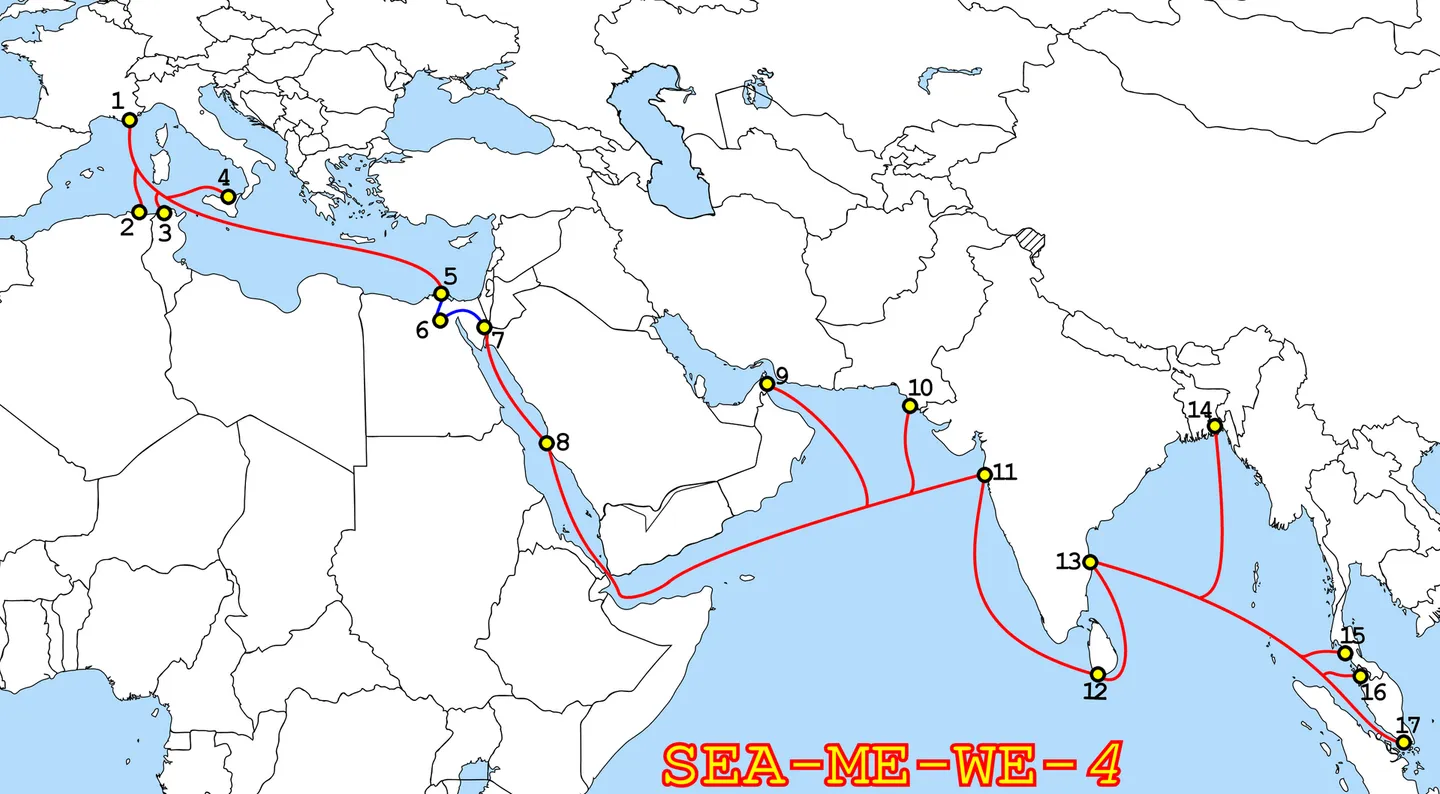
The route of the submarine cable SEA-ME-WE-4 ( From Wikipedia) -
The South East Asia–Middle East–Western Europe 5 (SEA-ME-WE 5) is an approximately 20,000-kilometre submarine fibre-optic cable system connecting Singapore and France. It links Southeast Asia, the Indian subcontinent, the Middle East, and Europe, with an initial design capacity of 24 Tbps across three fibre pairs.
Construction began in June 2014 and was completed in December 2016. In September 2019, its design capacity was upgraded to 36.6 Tbps using Ciena’s GeoMesh Extreme 300G technology. In Bangladesh, the cable’s landing station is located in Cox’s Bazar. In Bangladesh, the cable’s landing station is located in Kuakata. (Source: Wikipedia)
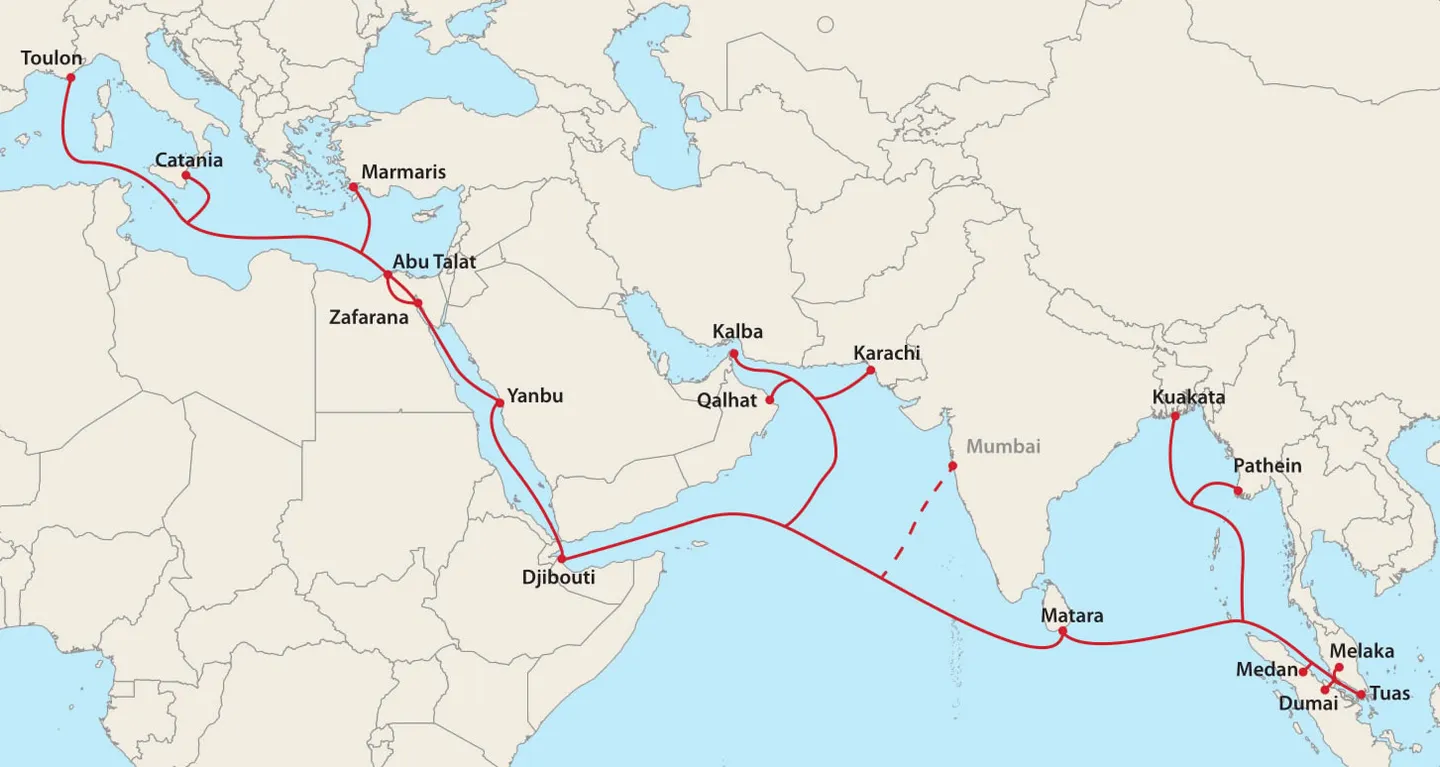
Route of SEA-ME-WE 5 (Wikipedia) -
SEA-ME-WE 6 (SMW6): South East Asia–Middle East–Western Europe 6 (SEA-ME-WE 6) is a submarine fibre-optic cable system designed to connect Southeast Asia, the Middle East, and Western Europe. Construction began in February 2022. The 19,200 km cable is designed to deliver a total capacity of 126 Tbps using Spatial Division Multiplexing (SDM) technology.
The SEA-ME-WE 6 consortium includes 21 countries, including Bangladesh, India, Pakistan, Singapore, Malaysia, France, and Saudi Arabia. (Source: Wikipedia)
BSCCL (Bangladesh Submarine Cables PLC; formerly Bangladesh Submarine Cable Company Limited) plays a key role in managing Bangladesh’s submarine cable infrastructure and capacity. If cable repairs, maintenance, or faults occur on international segments, bandwidth and latency may be affected temporarily. Having multiple cables provides path redundancy.
International Terrestrial Cable (ITC)
ITC refers to overland international fiber connections. Bangladesh exchanges international traffic with neighboring countries like India via terrestrial cross-border links. The Benapole–Jessore region is prominent for such connectivity. ITC provides an alternative and complementary path to submarine cables; however, the proportion of bandwidth sourced from each medium varies over time based on policies and market conditions.
Key Entities and Roles in Bangladesh’s Internet Ecosystem
International Internet Gateway (IIG)
IIGs handle the ingress (entry) and egress (exit) of international internet traffic. IIGs acquire capacity from international carriers, submarine cables, or ITC-connected upstream networks and supply it to domestic networks. Think of the gateway as the “front door” to global networks. Routing, peering contracts, and network policies dictate which IIG or international path specific traffic takes.
Nationwide Telecommunication Transmission Network (NTTN)
NTTN entities manage fiber-optic and other transmission infrastructure across different regions of the country. They can be compared to the circulatory system (veins and capillaries) of the telecommunication ecosystem. NTTN networks provide backhaul and transmission links between IIGs, mobile operators, ISPs, enterprises, and other telecom networks.
Examples: Summit Communications, Fiber@Home, and certain transmission services of state-owned BTCL. Licensing categories and service models vary, so each entity’s current operational role should be reviewed individually.
Internet Service Provider (ISP)
ISPs deliver the internet connection directly to the end-user. Home broadband ISPs typically buy upstream bandwidth and rent transmission infrastructure, deploying their own access networks to connect customers.
- Larger ISPs may provide wholesale/upstream services to other ISPs or networks.
- Local, smaller ISPs may source connectivity from larger ISPs or networks to service specific neighborhood areas.
Note on Tier 1/Tier 2: These terms originate from global peering definitions; classifying Bangladeshi ISPs strictly by these tiers does not capture all practical operational roles.
Internet Exchange Point (IXP)
An IXP is infrastructure where multiple independent networks exchange traffic directly with one another locally (peering). Accessing local content, video caches, gaming servers, or other Bangladeshi networks can occur without routing data through expensive international paths. This reduces latency and lowers transit costs. BDIX (Bangladesh Internet Exchange) is the most widely recognized IXP in Bangladesh.
An IIG connects to international internet transit/gateways, whereas an IXP facilitates local/peer traffic exchange between domestic networks. They perform fundamentally different functions.
Bangladesh Telecommunication Regulatory Commission (BTRC)
BTRC is the regulatory body for the telecommunications sector in Bangladesh. Its responsibilities include licensing, regulatory guidelines, spectrum allocation, Quality of Service (QoS) enforcement, interconnection, and policy decisions.
International Gateway (IGW)
IGW handles the ingress and egress of international telephone/voice traffic. When a call comes to a Bangladeshi number from abroad or is made from Bangladesh to an international destination, IGWs manage the routing.
Mobile Operators
Mobile Network Operators (MNOs) such as Grameenphone, Robi, Banglalink, and Teletalk deliver voice and data services via Radio Access Networks (RAN/cell towers), core networks, and associated infrastructure. A mobile tower is not the internet itself; it connects to the operator’s core network via backhaul links.
Interconnection Exchange (ICX)
To complete calls between customers of different telephone operators, inter-operator connectivity is required. ICX (Interconnection Exchange) acts as a central intermediary for routing voice traffic between different domestic networks. Call routing paths within the same operator differ from those crossing operator boundaries.
Newsletter
Learn with me
Join the newsletter to receive my latest articles. No spam, unsubscribe anytime.
You'll get a confirmation email. Check your inbox to complete your subscription.
About the author

Abdullah Islam
Abdullah Islam is a computer networking learner, tech blogger, and enthusiast who shares simple, practical guides to help others understand networking concepts and build real-world skills.
Comments